PublicationOct 2026
BuddyBack: A Multimodal Smart Posture Correction System
A desk-mounted edge device that tracks sitting posture with on-device pose estimation and corrects it through haptic and visual feedback. Published at ICMI ’26; in a 30-person user study every participant reported better postural awareness and none found it intrusive.
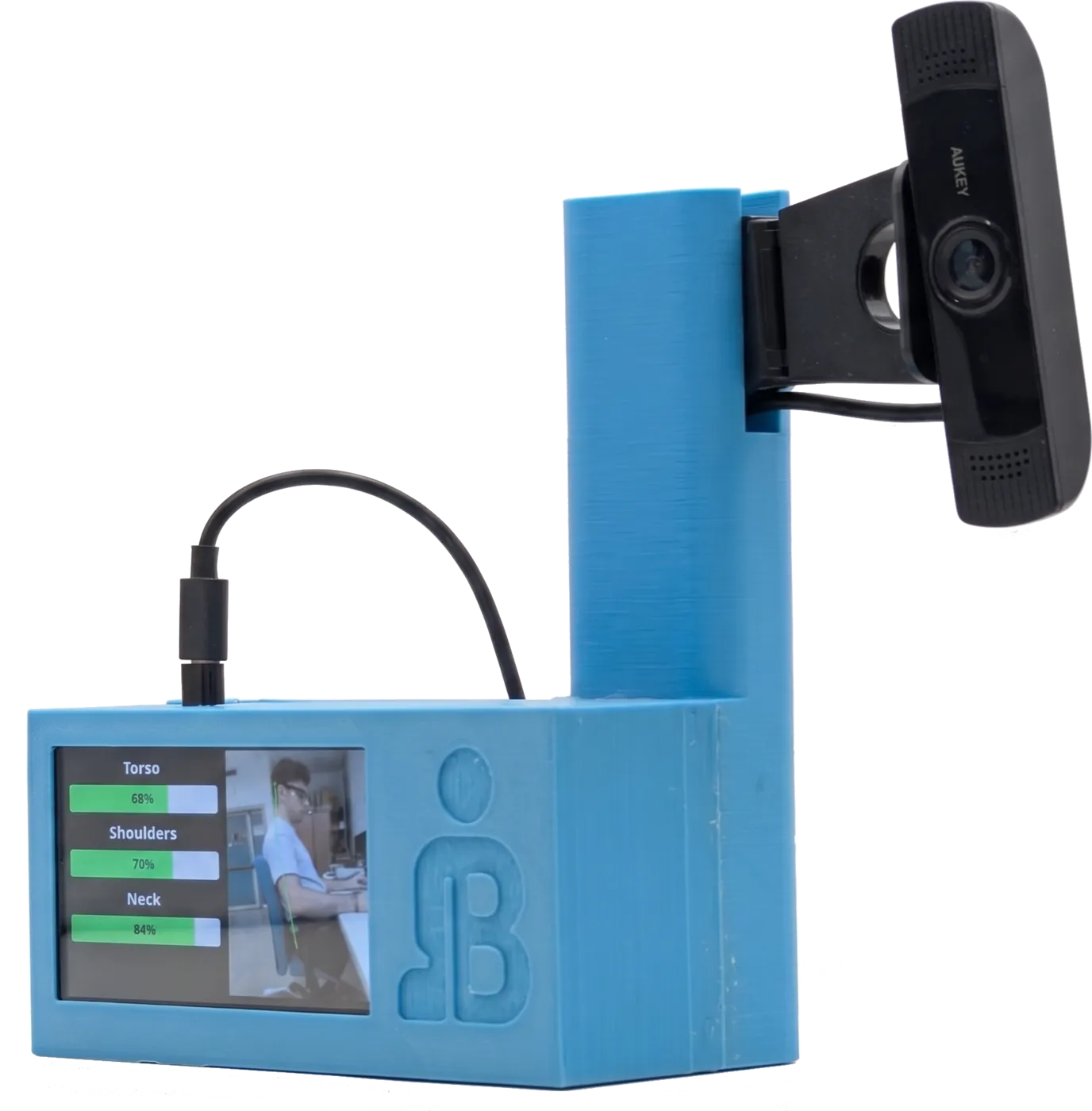
Poor posture affects a large share of students and office workers, and the existing fixes each come with a catch: wearables have to be worn all day, smart chairs tie you to one piece of furniture, and on-screen alerts are easy to ignore when you are concentrating. BuddyBack is a small device that sits on the desk next to you and nudges you back into a good position without asking for attention.
How it works
The prototype is a Raspberry Pi 4 in a 3D-printed enclosure with a USB camera, a 4.3-inch touchscreen and a vibration motor. It sits about a metre away, to the side, and watches your upper body in profile.
- Pose estimation on the device. MoveNet Lightning extracts body joints at about 17 FPS on the Pi. Camera frames never leave the device, so nothing sensitive goes over the network.
- Three posture scores. From the joints the system computes a neck score (forward head tilt), a torso score (leaning or slouching) and a shoulder symmetry score, each from 0 to 100.
- Smoothing over two time scales. A 30-second window drives the on-screen bars; a 120-second window decides when to alert, so that a quick stretch does not trigger anything.
- Haptic alerts through the desk. If posture has been poor for at least half of the last two minutes, and no alert was sent in the previous five, the motor sends three short pulses. The vibration travels through the desk surface instead of touching the user.
- A web dashboard with long-term statistics and a light gamification layer: ranked tiers from Bronze to Diamond for each body area, streaks and session history.

Tuning the alerts
The first version vibrated far too often and testers found it annoying. A preliminary study with 10 people using the device for 45 minutes each set the thresholds and the five-minute cool-down that the final version uses. Users also preferred vibration to sound: it is less embarrassing in a shared room and does not pull your eyes away from the screen.
User study
30 participants, mostly university students, used their computer as they normally would with BuddyBack on the desk and minimal instructions, then answered a questionnaire on a 4-point scale.
| Measure | Result |
|---|---|
| Feedback clarity rated 4/4 | 70% (the rest 3/4) |
| Reported better postural awareness | 100% (70% at 4/4) |
| Rated it intrusive (3 or 4 out of 4) | 0% |
| Found it helpful (4/4 or 3/4) | 90% |
Participants asked for lower webcam latency, a quieter motor and a check for chair height, which point to the next hardware iteration.
My role
I am co-first author with Marco Realacci and Lorenzo Spataro (equal contribution), with Danilo Avola, Maurizio Mancini and Emanuele Panizzi at the Department of Computer Science, Sapienza University of Rome. The paper appears in the ICMI ’26 proceedings (ACM). The federated learning work on the same device is described in a separate project page.